
Introduction
Every project estimate contains assumptions. Every implementation plan contains assumptions. Every resource forecast contains assumptions. The problem begins when organizations stop identifying, validating, and revisiting those assumptions as new information becomes available.
Assumptions Are Necessary
Many healthcare integration projects begin before every requirement, workflow, interface, or dependency is fully understood. Organizations still need budgets, timelines, and resource plans. As a result, assumptions are often necessary to move forward.
Assumptions help guide the planning to provide the basis for anticipated risk with the goal being to understand their impact. A project with ten documented assumptions is often less risky than a project with two undocumented assumptions.
Assumptions Require a Foundation
When assumptions are made without any supporting information, they cease to be assumptions and become speculation. An assumption should be based on some level of known information. Examples include:
- Historical project data
- Similar implementations
- Existing architecture
- Resource availability
- Vendor capabilities
The Cost of Overestimation
Project estimation discussions often focus on the risks of underestimating effort. Underestimation can lead to missed deadlines, budget overruns, resource shortages, and stakeholder dissatisfaction. While these risks are real, overestimation carries costs of its own.
When an organization overestimates a project, it may reserve budget, personnel, and schedule capacity that are never ultimately required. Those resources become unavailable for other strategic initiatives, operational improvements, or regulatory priorities. As a result, opportunities are delayed not because of actual work requirements, but because decisions were made based on inaccurate assumptions.
Overestimation can also influence executive decision-making. Projects may be postponed, reduced in scope, or rejected entirely because the estimated investment appears too large. In these situations, the estimate itself becomes a barrier to progress.
Perhaps most importantly, overestimation can create a false sense of security. Large contingency buffers may mask emerging risks, reduce urgency around unresolved assumptions, and discourage the continuous refinement of project plans.
Assumptions are about providing decision-makers with the most realistic assessment possible based on the information available at the time. Both underestimation and overestimation distort decision-making. The goal is not simply to avoid missing the estimate; it is to enable better organizational decisions.
Assumptions Are Not One-Time Events
Many organizations treat assumptions as static. Once documented, every decision is based on the initial assumption without challenge or refinement. Each assumption should follow a rigorous reconciliation process. This discovery can help validate:
- Which assumptions become facts.
- Which assumptions are disproven.
- New assumptions that emerge.
Project success often depends less on the original estimate and more on how effectively assumptions are managed throughout execution.
Closing Thought
In healthcare IT, assumptions are unavoidable. Complex implementations often begin long before every detail is identified. The problem is not that assumptions exist. The problem is treating assumptions as facts.
The most successful organizations do not attempt to eliminate assumptions. They identify them, document them, validate them, and continuously reconcile them as new information becomes available.
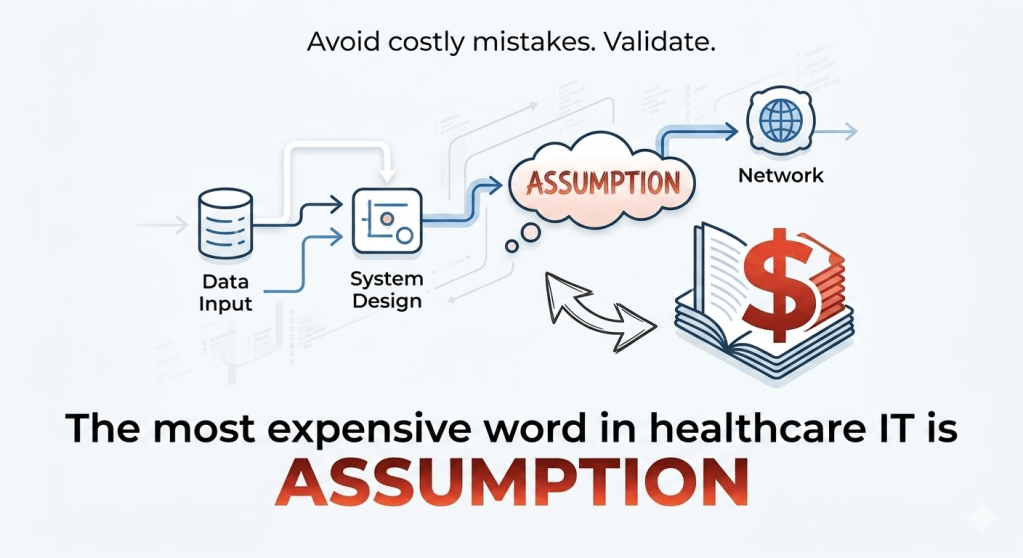
The most expensive word in healthcare IT is “assumption” because when assumptions go unchallenged, every decision built upon them becomes exponentially more expensive.
 James DeBiase Healthcare Interoperability Expert
Leave a comment