Introduction
Healthcare organizations frequently measure interface performance through availability metrics such as uptime, message throughput, and transaction success rates. While these metrics are important, they only answer whether data moved from one system to another. They do not answer whether the data arrived accurately, completely, or in a manner that preserves its intended meaning.
Most interface endpoints can only detect the structural integrity of a transaction. The receiving application will process that data based on matching criteria. A transaction that meets the minimal structure and matching criteria will be processed regardless of whether the transaction contains any additional data or bad data.
As healthcare organizations increasingly depend on interoperability for clinical operations, revenue cycle management, analytics, and artificial intelligence, understanding the distinction between interface availability and data integrity becomes critical.
Availability versus Integrity
Healthcare organizations have a propensity for data that measures availability, with many organizations proudly reporting: 99.9% interface uptime, zero downtime incidents, successful message delivery rates. These are easy metrics to measure. An interface engine can report that one million HL7 messages were successfully transmitted yesterday. Those statistics are important but only tells part of the success picture. That statistic says nothing about whether:
- Clinical observations mapped properly
- Financial transactions were complete
- Data was interpreted consistently between systems
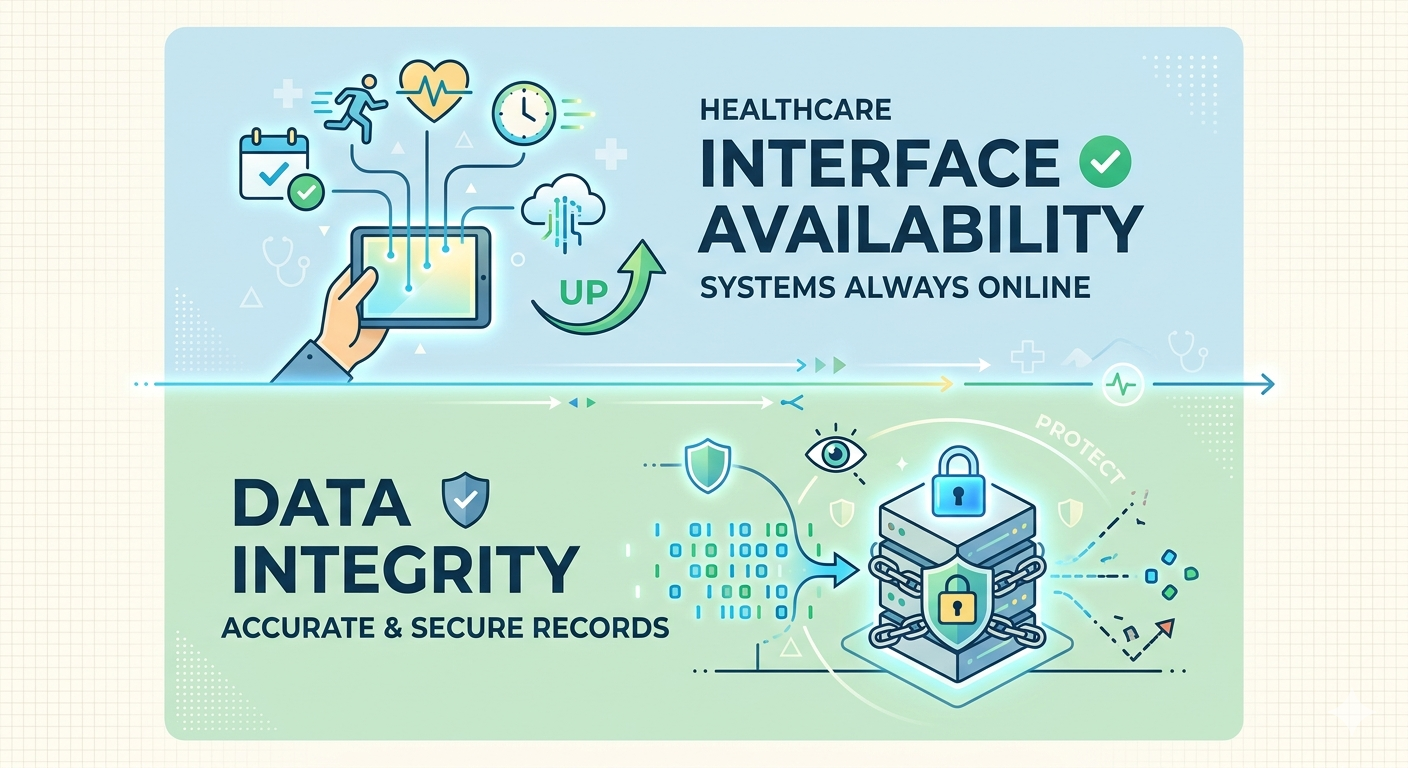
Availability measures transportation. Integrity measures trustworthiness. This distinction is often overlooked by executives because availability is visible and measurable, while integrity failures are difficult to identify and quantify.
Availability answers questions such as:
- Is the interface operational?
- Can messages be transmitted?
- Is the connection active?
- Are messages reaching the destination?
Data integrity addresses whether information remains:
- Accurate
- Complete
- Consistent
- Timely
- Unaltered from intended meaning
In other words, did the receiving system understand the data exactly as the sending system intended? Data integrity failures occur when data technically arrives but is corrupted, transformed incorrectly, truncated, duplicated, delayed, or misinterpreted.

Why Integrity Problems Are More Dangerous Than Downtime
When an interface fails, alerts are generated, and teams investigate. Users recognize a problem exists until resolution is communicated. When integrity fails, the data continues flowing, and the consumers trust the information is complete and accurate. Clinical and financial decisions continue to be made while the problems may remain hidden for months. A complete outage creates visibility. An integrity issue creates false confidence.
Measuring Integrity Instead of Assuming It
Unfortunately, most applications do not measure data integrity. This requires custom coding unless the errors are logged in a database. Even more challenging is incomplete data. With HL7 and FHIR, if the structure is complete and the required field is populated, the transaction is successful. However, one misplaced delimiter and data is now incomplete. The only way to ensure data integrity compliance is to perform periodic audits of the source and destination applications. With a robust integration engine, it may be possible to compare the raw inbound with the transformed outbound. This requires resources and the commitment to perform the audits.
Conclusion
Healthcare organizations cannot achieve interoperability simply because systems exchange data. True interoperability exists when information is exchanged accurately, completely, and consumed exactly as it is intended. Availability demonstrates that systems can communicate. Data integrity demonstrates that data can be trusted. In healthcare, trust—not transmission—is the ultimate measure of interoperability success.
Leave a Reply